Saturday, December 1, 2018

What Are the Steps and the Objectives of Making Prototypes in China?

By Fabien Gaussorgues
Are you going to manufacture a mechanical and/or electrical product in China? This article will help you plan for the steps for follow.
You might need a concept of the product, to show investors and to launch a Kickstarter campaign.
You might need a prototype that is close to the final version of the product, in order to run testing (including usability testing) and validate the design before going into production.
The usual process goes as follows. (The steps are often overlapping, but for clarity let’s break them down one by one.)

Step 1: design the product

We are talking CAD drawings, PCBA schematics, and so on. Do this yourself (or through a design firm working for you), so that you own all the blueprints from the start. Don’t make the mistake of having a Chinese manufacturer do it, as they will certainly consider that they own all intellectual property rights.

Step 2: check and confirm that all parts of the product can be made/purchased

The parts need to be purchased and/of fabricated before a prototype can be assembled.
This is when someone has to start working on sourcing. Depending on the complexity of the prototype, it might take some time. It will confirm whether cost targets are achievable and will uncover some of the technical difficulties (what parts, if any, are hard to find in China).
Many shortcuts can be taken at this stage. Typically, the plastic and metal parts that have to be custom-made can be fabricated without investing in expensive tooling (that comes later in the process, once there is less uncertainty).
In case the product includes a very specialized module that is central to overall performance/design, it is better to do the hard work of identifying and qualifying the supplier, and to have that supplier start working on customizations (if any), at this stage. This is often a complex sub-assembly that becomes a project in itself.

Step 3: assemble the prototype

Once all the parts are ready, assembly can take place. Feedback such as “these 2 components are hard to kit together” is very important and will call for changes.
After that, many other issues are typically found. For example:
  • Functionality issues
  • Performance issues (e.g. much tuning is needed)
  • Poor ergonomy for users
  • Overall ‘look’ issues (a glossy part does not match with a matte part, etc.)
At this stage, design and prototyping iterations are often necessary until all major issues have been addressed.

Step 4: tooling for production

Once a prototype has been made with final parts and has been approved, tooling can be ordered. For example, a plastic injection mold for the casing. (Make sure you have the right type of contract before wiring any money — read this article on the China Law Blog.)
Do a first article validation on a few parts made with the new tooling, and sign off if all is acceptable.
Do not forget testing equipment, which sometimes takes weeks or months to prepare.

Step 5: tests and validations

You want to avoid surprises in production. Spend some time at this stage to do in-depth testing:
  • For compliance (safety, battery cells…)
  • For performance, including stress testing
  • For robustness
  • For the use of key features
Many people are tempted to go into production as early as possible. However, an issue discovered before production starts is much faster and much cheaper to fix (by a factory of 10, 50, or 100).
For similar reasons, it is usually considered a must to do at least 1 pilot run before launching mass production.
For more context on bringing a new product to life, I suggest you watch our video on this topic.

Investing in an Injection Mold: What Is Best Practice in China?

Many importers are puzzled. They ask quotations for a plastic part, and Chinese suppliers quote wildly different amounts for the injection mold.
One reason, obviously, is the nature of the mold:
  • Is it in hard metal (e.g. H13 steel), ready to make hundreds of thousands of pieces? Or in soft metal (e.g. aluminium), for making a few prototypes only?
  • Is it a single cavity mold (requiring more machine time and more labor)? Or multi cavity (more expensive, but more efficient for large production runs)?
  • There are other considerations, of course, but these are just 2 examples of things to specify. See a list of design mistakes and a list of common defects to have an idea of what can go wrong…
And another reason is the business approach of the supplier. What game do they want to play? I listed the main 3 options:
  1. You let the supplier make the mold at their cost, the mold is theirs. They include it in the price of the finished product, but you don’t know by how much. This is more expensive in the long run, and you have no control over the supplier (they own the molds you need for your production).
  2. The supplier partially subsidizes the mold, the mold is theirs, and again they plan to amortize over time in the price of the plastic parts. This is also expensive in the long run, and you also have no control over the supplier.
  3. You pay the full price of the mold, you have a contract (enforceable in China) that says all the tooling is yours and you can get it back, and then you can use the forces of competition to keep the injection molding job affordable over the long term. This is also the safest option when it comes to IP protection.
If you plan to make small production runs and you don’t mind if your competitors get access to the same mold, then all the best if a Chinese manufacturer is ready to subsidize it!
In, on the other hand, you plan to make relatively large series of that plastic part, and if you want to keep control over who uses the tooling, go for option 3.
There are a few things most buyers don’t think of.
First, you need to have an agreement with the supplier that they maintain the mold. They should not store it in a dusty or humid place. They should re-make it if they damage it. And so forth.
Second, what happens when the tooling gets to the end of its useful life?
There are two options:
  1. Let’s say your order volume is very high. Supplier might accept to make new tooling for free in order to continue production, without raising the unit cost of the plastic parts.
  2. Supplier makes the new tooling in order to continue production, and the full price is paid by the customer (same as option 3 as outlined above).
Overall, in the long run, investing to own and control the tooling is usually the cheapest proposition. One notable exception is the prototyping stage, where having a supplier make cheap tooling on their own can make good sense.

Selecting a Contract Manufacturer (CM) for Your Electronic Product in China

In China, there are a few entirely different breeds of manufacturers you can work with. One of them in the contract manufacturer (CM).
Working with a CM makes sense when you purchase relatively high volumes (e.g. more than 10,000 pieces a year for electronic products). You will get the best results in cost and quality with a CM.
In OEM, ODM, Contract Manufacturers: Choose your China Supplier Wisely, we listed the pros and cons of working with a contract manufacturer:
Pros:
  • The buyer is expected to own the design and to pay (and own) the tooling.
  • The buyer can sometimes negotiate for visibility over the supply chain, which reduces many of the risks.
  • Better control of the situation as a whole – cost, quality, and timing.
  • Change from one CM to another is a relatively standard process.
  • The CM generally accepts a certain amount of manufacturing-related liability.
Cons:
  • There is more R&D work.
  • Time to market is usually longer.
  • The testing and validation plan should be defined from scratch and adjusted over time.
However, there are different breeds of contract manufacturers. Not all will be a good fit for your company.
Here are the key questions you need to answer before starting to look for a good CM.

1. What quantity are you planning to order in the first year? In the second and third year?

A large CM would not both with a customer that orders small quantities. They typically have a relatively heavy onboarding program a new customer, including setting up the production & testing processes, confirming what standard they agree with, and so on.
Some of them, who really, really don’t want quality issues in mass production, will insist on re-starting the New Product Introduction process nearly from scratch (from the design reviews). That’s not something they can justify for a business volume of 100,000 USD a year…
Another issue is, they are much more interested in continuous production (dedicated lines that are setup once and then keep running) than in start-and-stop jobs.
A smaller CM is a better fit if you are starting from a low position and you can’t confirm to order many thousands of pieces a month in the near future.

2. Do you need production in a high-volume, low product mix setup?

If you want just 1 or 2 SKUs to be made in the tends or hundreds of thousands of pieces, most CMs will be very excited to get your business. And then it becomes a game of cost control and transparency (see next point).
If, on the other hand, you have a variety of SKUs to manufacture in relatively low quantity, the challenge will be finding a factory that is optimized for flexibility.

3. Do you expect transparency on the component suppliers?

Some buyers want a ‘turnkey solution’ and have no interest in the details. Other buyers want more control over their supply chain and require visibility all the way through.
For example, Ikea knows what forests many of the wood materials going into their furniture come from, and they use that information to guarantee a level of sustainability but also to drive improvements in their supply chain. This is an extreme example, but at the very least do you want to know who supplies the main components going into your product?
Not all Chinese suppliers can accept to be transparent. Have this discussion early on.

4. Is protection of your intellectual property extremely important?

If the answer is yes, you can’t take the risk of working with a potential competitor.
Some importers discovered, to their horror, that their ambitious ‘manufacturing partners’ had decided to expand into more profitable activities and had started selling directly on their market… and were making good use of what they had learned (design, production process, software, and so forth).
This is more likely with a Chinese-owned CM than an American-owned CM, and with any hard-driving and reckless business owner in general.

5. Do you expect the CM to help you with product development? With compliance?

You will need to look at their engineering capabilities. The more you can rely on their internal resources, the cheaper your new product development will be.
When it comes to compliance, look at their past experience making similar products for your market. Ask questions to test their understanding of legal requirements and how to address them. They might have been selling a similar widget to the US, but their American customer might have been handling that process from A to Z!

6. CM capability (plastic parts, metal parts, PCBA… or just assembly)

What processes do they have in-house? The more a typical CM does in-house, the more control they have over timing and quality… and the better results.
However, it is usually cheaper when the assembly plant buys parts from smaller factories that are focused on just one type of process. Expect higher prices if you purchase from a vertically-integrated plant. It doesn’t necessarily make sense conceptually, but that’s what have observed again and again in China.
If they buy some critical components from outside, see if they already buy the same components (same grade, etc.) for their other customers. Pooling all their purchasing power gives the CM more power to negotiate quality, timing, and other key terms with their suppliers.

7. QC capability and testing equipment

You will need to look at their internal testing laboratory (if any). Do they have the right equipment? Does it all seem to be in good condition? Can they speak intelligently about the key tests, their roles, past failures they caught, and their reaction plan?
Also, ask about the transparency of their internal QC activities to their customers (in 99% of cases, there is no automatic transparency). Observe the way they work, guess the speed at which issues would typically be caught, and look for evidence of quick feedback to the production process (or the sub-supplier) at the origin of the issue.

8. Test jig developments

Do they have elaborate in0line testing equipment? Do they do it themselves, was it all designed by a sophisticated customer, or is it subcontracted to a specialized firm?

9. What level of liability do you expect from your CM?

In China, the default approach is ‘once it has been shipped out and full payment has been wired, supplier bears no responsibility”. And, in many cases, Chinese CMs think and behave this way. Is this what you want?
What if you have to recall an entire batch of products because of battery problems? Who will absorb that cost?
What if a customer takes your company to court because of a manufacturing problem. Who will be responsible for this in the end? What if they infringe on your intellectual property?
In other words can the CM accept to sign a contract that would be typical in the West? Or will they cling to what they consider is ‘standard’ in China?
[Update: the China Law Blog posted an article with a number of good points to consider in a contract.]

10. What payment terms can they offer?

One great approach to hold the CM responsible is to delay all, or a portion of, the payments. If issues happen, chargebacks are simply deducted from the balance payment.
It can be very hard to negotiate. The company that does assembly usually has to pay for components and materials long before shipment. But 30 to 60 days net payment after delivery will help your business immensely. You can scale it up much faster with the same amount of working capital.
To increases your chances of getting this type of deal, you will probably need to demonstrate strong financial backing, as well as a strong position on your market. And you need to be good at ‘selling’ your project and getting CMs excited.

11. Delivery terms

Again, do you want to go with the usual FOB terms that are so common in China? It makes sense for the buyer to control shipment and have visibility over the entire inventory.
If you can really trust your CM, they can ship to you in DDU or DDP terms (all the way to your warehouse). It is more convenient for the buyer.
I hope this list is useful if you are looking for a contract manufacturer. There are some very good options in China, and not only for electronic products.
Large CMs are not the best fit if your orders are not very large. It can be difficult to find a smaller CM since they are less well-known and have less marketing punch, but it is not impossible.

No Process Improvement Action Plan in Chinese Factories? Why?


In good factories, the leaders look at the future and wonder how to make their company stronger. They usually have an action plan that will support process improvement. That’s how they will improve their quality, cut lead times, and contain costs.
When I go to Chinese factories, managers very seldom tell me “here is our action plan”. They seem to respond to every day’s urgencies:
  • A supplier is late in delivering some materials, and the customer will ask us to send the goods by air? Let’s call the supplier, or go and see them, right away.
  • A key supervisor just quit? Let’s figure out how to keep his department going for the day.
  • A batch was rejected for poor quality? Let’s look at the the issues and decide what to do.

Do they really have no plan for improvements?

Actually, they often do. The boss will have a few priorities in mind — most of them on how to get new customers, and a few about their operations.
There are generally 2 issues with these plans:
  • Low priority given to operation improvement — making new sales always seems to come first. A larger business, they reason, will have more resources for getting operations in better shape.
  • No structure — they don’t stem from a rational approach (starting from a risk & opportunities analysis, broken down in actionable steps, documented so people know what they are responsible for, etc.)
That’s quite frustrating. Most of the middle managers still don’t get the fact that highly efficient and capable processes will get them better grades on customer audits, will make current customers happier, and will have a direct impact on sales.
Or, when they do get that fact, they are pretty cynical about the whole reasoning. It sounds too simplistic to them.

How to arrive at a good process improvement action plan?

Make good use of the 7 basic quality tools. That’s probably all you need! As Dr Ishikawa wrote:
From my past experience, as much as ninety-five percent of all problems within a company can be solved by means of these tools.
So, how to use these tools for driving quality improvement?
  1. Make a list of past issues (the “check sheet” tool, or any number of other ways of collecting data)
  2. Sort them by frequency (the “pareto chart” tool)
  3. Select the 1 most frequent issue
  4. Analyze it with the “cause-and-effect diagram”, break the process down with a flow chart, try to find patterns with the “histrogram” or the “scatter diagram”
  5. Select the 1 or 2 main causes of that issue, and drill down to the root cause(s)
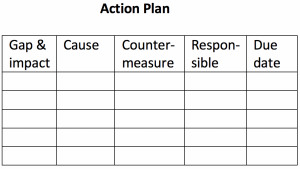
  6. Set up an action plan to address the main root causes: Action  |  Responsible person  |  Due date  |  Status
  7. Implement the actions, measure results, keep it in place if the issue comes up less often
  8. Go back to step 2, select the second most frequent issue, go over the process again
  9. Every time, make sure to document the changes and to find ways to make them permanent.
That’s the best way I know to fix issues, and to improve processes, in a relatively short amount of time.
Other approaches also make sense, depending on the goals.
If you want to reduce cycle times, you might want to do as follows:
  1. Draw a value stream map of the entire production, and include production of the main materials/components if possible
  2. Look at areas where much inventory builds up. Can you raise the capacity of the process immediately following those areas (they are probably bottlenecks.)
  3. Can you find ways to reduce changeover times in some processes? (For example, do you really need to stamp 10,000 pieces of the same part before changing to another part?)
  4. Can you “connect” two processes, so there is no need for a time & inventory buffer between them?
  5. Draw a “future state” map that can be implemented in the next 3-6 months
  6. Break down the tasks, and set an action plan:  Action  |  Responsible person  |  Due date  |  Status
  7. Review the action plan regularly, make progress visible, keep pressure on
  8. Once you have implemented the whole plan, go back to map the system again, confirm lead times are markedly shorter, and start again at step 1
Same approach if the goal is variable cost reduction: build a model in Excel that replicates the cost structure, break it down and analyze it until you see the main cost drivers, etc.
As I wrote above, it takes a structured approach, involvement of the team that will have to do implementation, and (the hardest of all) continued focus and commitment over time.
What do you think?

Bad China Suppliers Quality: Still Tolerable in 2018?


When people ask me if the quality of China-made products has improved over the past 10 years, they expect me to say “oh yes, certainly”. However, the reality is not that simple.
I think an interesting approach is to divide the market in 3 wide categories where the reality is quite different.
In the end, the conclusion is simple.
  • If buyers can’t tolerate bad quality, then they will get better products. Whether in China or somewhere else.
  • If they can tolerate a substandard batch from time to time (even if they protest, scream, jump on a plane… and they lose serious money), the rate of improvement will be slow… or nonexistent.
Let’s see how it plays out.

Market 1: poor quality absolutely not tolerated by buyers

Do you think a tier-one supplier of seats to Ford Motor Company is allowed to ship 2% of defective products? No way — all the chargebacks would bankrupt that supplier. They’d get a lot of verbal abuse too, but that’s not sufficient. They would get hit where it really hurts — their bank account.
Do you think Microsoft lets a contract manufacturer (CM) that assembles Surface laptop ship computers that have a fan problem or a screen problem 1% of the time? Definitely not acceptable.
Do you think Siemens buys wires for its FMRI machines from a manufacturer that hasn’t already checked them very thoroughly? Not a chance. They can’t afford a 4 million USD piece of equipment to fail and be returned from a hospital.
Automotive OEM. High-end consumer electronics. Medical devices. In these three industries, and a few others, buyers in Europe and North America have long decided bad suppliers’ quality is ABSOLUTELY and ALWAYS unacceptable.
The result? The Chinese companies that have managed to fulfil their expectations have risen their quality standards spectacularly.

Market 2: poor quality not accepted, but in facts still tolerated

Most consumer products made in China fall in this category.
I’d guess 99% of orders sent to the “Fulfilment By Amazon” model are on this market, too. Even though any serious quality issue means Amazon can close the seller’s account once and for all.
If you buy less than 1 million USD a year of a specific item, it is probably in this category. Why is that? Because you haven’t done all the upfront work required to “build quality in”:
  • You haven’t done reviews and iterations on the product design (based on drawings, functional prototypes that get tested in a reliability lab…)
  • You haven’t forced the manufacturer to prove that the process was capable of churning out good products the first time at a high percentage (thanks to a solid control plan, a pilot run…)
  • You haven’t qualified the main component suppliers and then forced them to prove their processes were capable too (same idea as previous point).
Of course, I do understand it is not always realistic.
In many cases, the importer simply selects a product already “on the shelf”, with or without slight adjustments. Going into mass production straight away is very tempting. And the manufacturer, which has already made that same product before for another customer, is not willing to go through all the upfront work I listed above. I get that.
But you should be aware of the consequence: an inconsistent process that yields inconsistent product quality.
Can you push the factory very hard and get them to make efforts in order to improve quality? Yes, sure. But, since they haven’t “built quality in” the product, they will have “inspect it out”. It means greater QC resources and higher prices.

Market 3: price drives the deals, at the expense of quality

I have observed this when it comes to discount apparel and footwear that are made in Shantou, Quanzhou, and other similar places. Same thing with all the cheap ‘fancy jewellery‘ products made in Yiwu.
Here are the mechanisms at work:
  1. Discount retailers keep looking for lower prices and de facto tolerate lower levels of quality.
  2. Importers/wholesalers got squeezed on price every year and had to find cheaper sources.
  3. Manufacturing gradually moved to the cities that offered lower prices… and where the average salesperson never heard a customer say “I wouldn’t mind paying a bit more if quality were better”.
A lot of this business has already left China. More labor intensive productions are often made cheaper in Bangladesh, Pakistan, or Vietnam, for example.
I always wonder if there is a bottom these players will hit. Or if their standards will keep getting looser. We had a few such clients 7-8 years ago and I am glad they left. Price was the over-riding factor in all their decisions, and they tended to work with the worst manufacturers…
Note, sometimes it is not price that is given a much stronger priority over quality.
Sometimes it is timing. When I think of all the give-away promotional items that HAVE to be shipped out by a certain date… and also made cheaply, of course… There are no real quality standards, and corners are cut all the time. Buyers know that and it’s the name of the game!

Will your company switch from market 2 to market 1?

I guess many readers who have made it so far are wondering, ‘how about us?’
If your margins have been eroding over time and the constant risk of quality issues puts your business seriously at risk, then maybe it is time to do the hard, upfront, preventive work.
It might mean working with a good contract manufacturer that already has all the right systems in place. It might mean giving an “upgrade now or we are leaving in 3 months” warning to your key suppliers. In all cases, it means looking at your supply chain and making changes.

When AQL Sampling Plans Can’t Find Defective Products

When AQL Sampling Plans Can't Find Defective Products

A reader sent me this interesting question:
I would like to better understand AQL usage and more precisely whether inspections based on AQL are effective in situations where the distribution of defects is not homogeneous within the lot.
Let’s say the lot is 25,920 pieces split in 36 boxes. From previous observations, most of the pieces in the lot are OK, but a few pieces (200-500) are not OK and they are physically located in a focused part of one or 2 boxes.
Is an AQL inspection the right approach in such situations?
That’s a very good question. This reader found a blind spot in the ISO 2859-1 standard (used in what they call “AQL inspections“.
And the reason is simple. The statistics assume that every piece in the batch has the same probability of being defective. If you receive a batch in bulk from a supplier, that’s a fair assumption.
But it isn’t always realistic. Here are a few examples:
  • A tool breaks in production, and the next 50 parts are defective. They are not segregated and are shipped together with other parts. They are all concentrated in the same carton box.
  • The manufacturer has 5,000 pieces to pack, but finds out that their supplier only shipped enough packing material for 4,900 pieces. They decide to use another material that is nearlythe same. It ends up in the last 2 carton boxes.
  • The production manager decides to ship the rejects from a past batch. He places 5 ‘bad’ boxes among the 200 boxes for this shipment.
If you really, really need to catch those cases, you need to do your sampling in a different way (for example, checking a few pieces in each box).

The Sad State of Quality Systems in Most Chinese Factories

The Sad State of Quality Systems in Most Chinese Factories
The sad truth in China is, 5% of the manufacturers are doing a good job consistently, and the rest have ups & downs that irritate and frighten Western customers.
And, of those 5% that do a good job consistently, 0.5% do so because of good systems and the other 4.5% do so because operations are not very complex and management watches what happens carefully.
Yes, I made these numbers up. But that’s my impression after 12 years spent working here across multiple sectors (from apparel to tier-1 automotive, and from furniture to electronics). Bad suppliers quality is still a real problem in China.
But why can’t these manufacturers even STOP BAD QUALITY? Because of a series of issues in the quality systems.

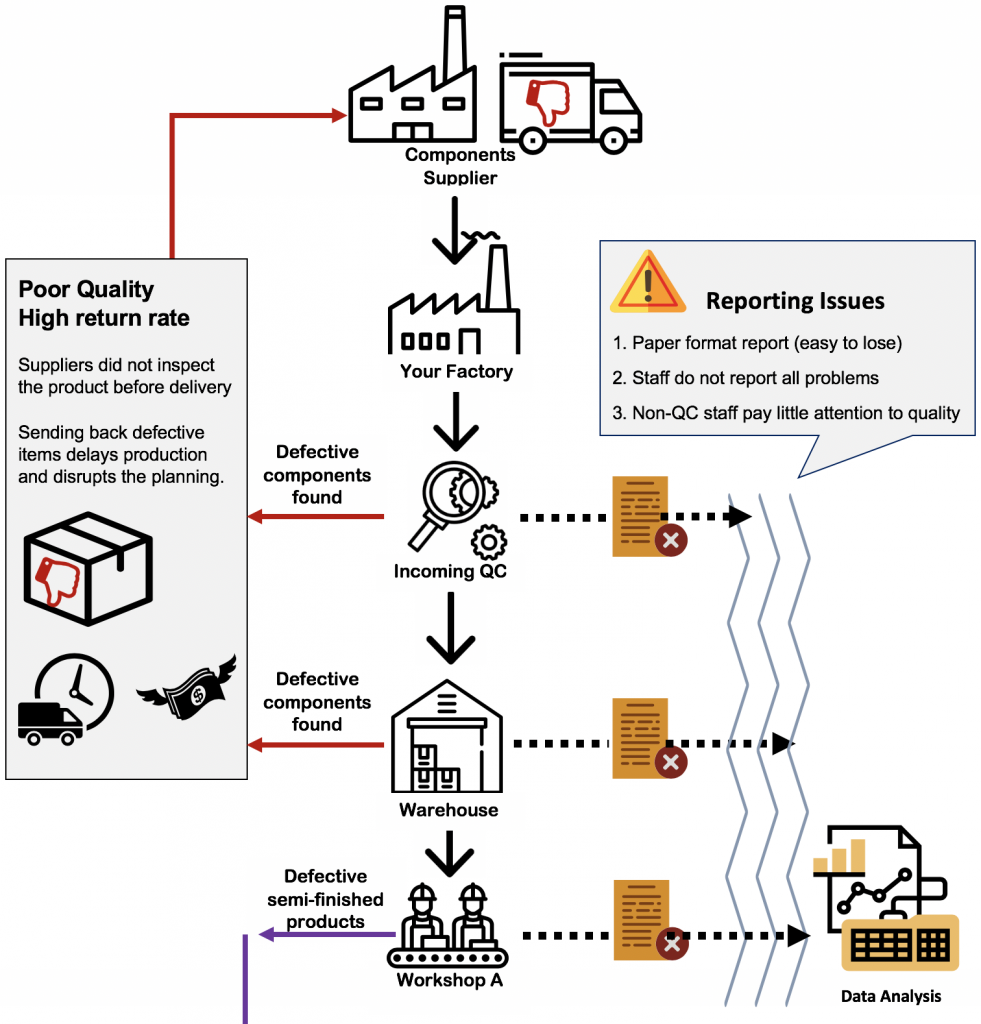
Typical gaps in the quality systems of Chinese factories

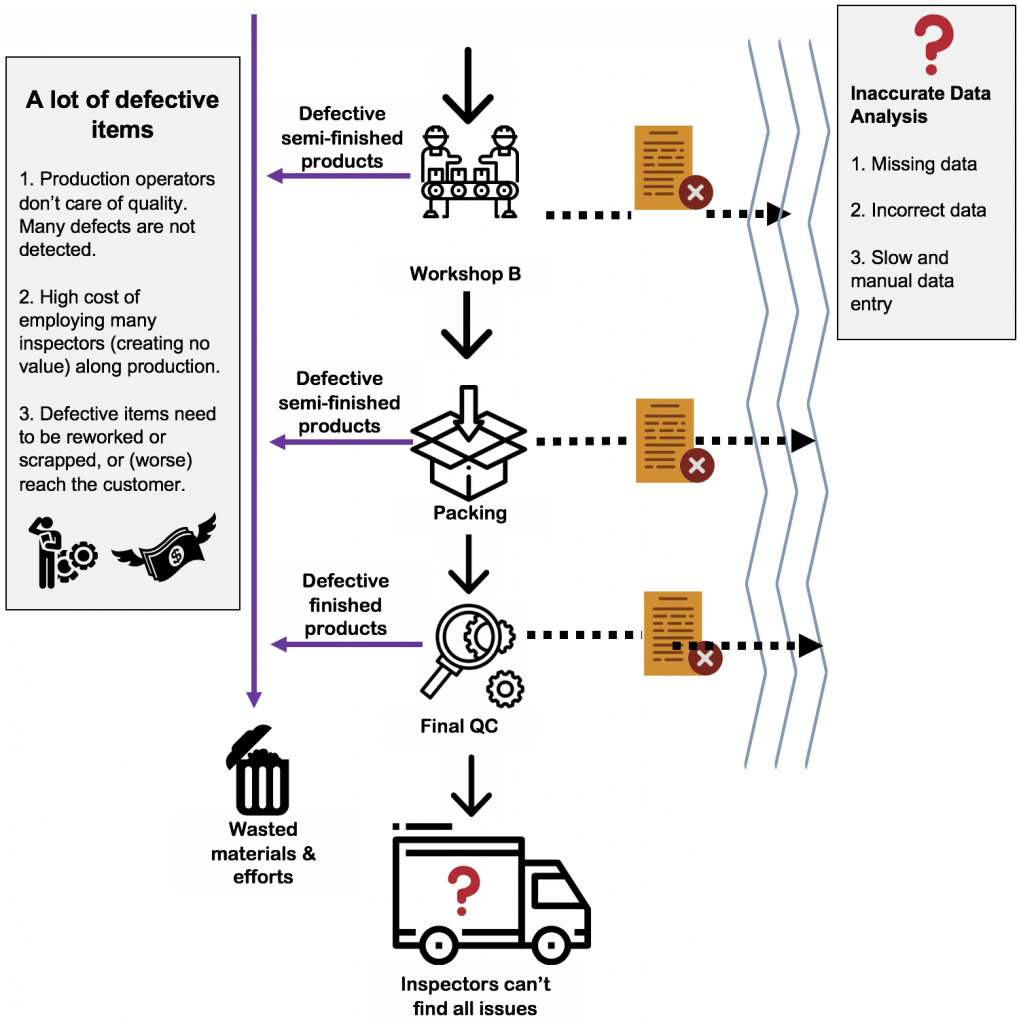
We drew this simple infographic to illustrate the issues we have seen most often.
Incoming Quality Control Issues
Does it sound familiar?
  • Inconsistent product quality from suppliers, which causes delays and other production issues
  • When inspectors do check production, they write findings on paper, and data integrity is a serious concern
  • QC is only the responsibility of the QC department, and the production staff’s performance is evaluated on the basis of quantity shipped.
  • The managers think “to ship fewer defective units, we need more inspectors to take the bad pieces out and it costs more”, rather than working on process controls and preventive maintenance.
  • Manpower and materials are wasted in rework and scrap.
  • Data analysis is quite difficult. It requires a lot of data entry, and is ready days after an issue has appeared.
  • No systematic feedback to the previous process, or to external suppliers.
  • Not all issues are caught. Customers are never sure their standard will be respected.
Is this what you see in your suppliers’ factories?